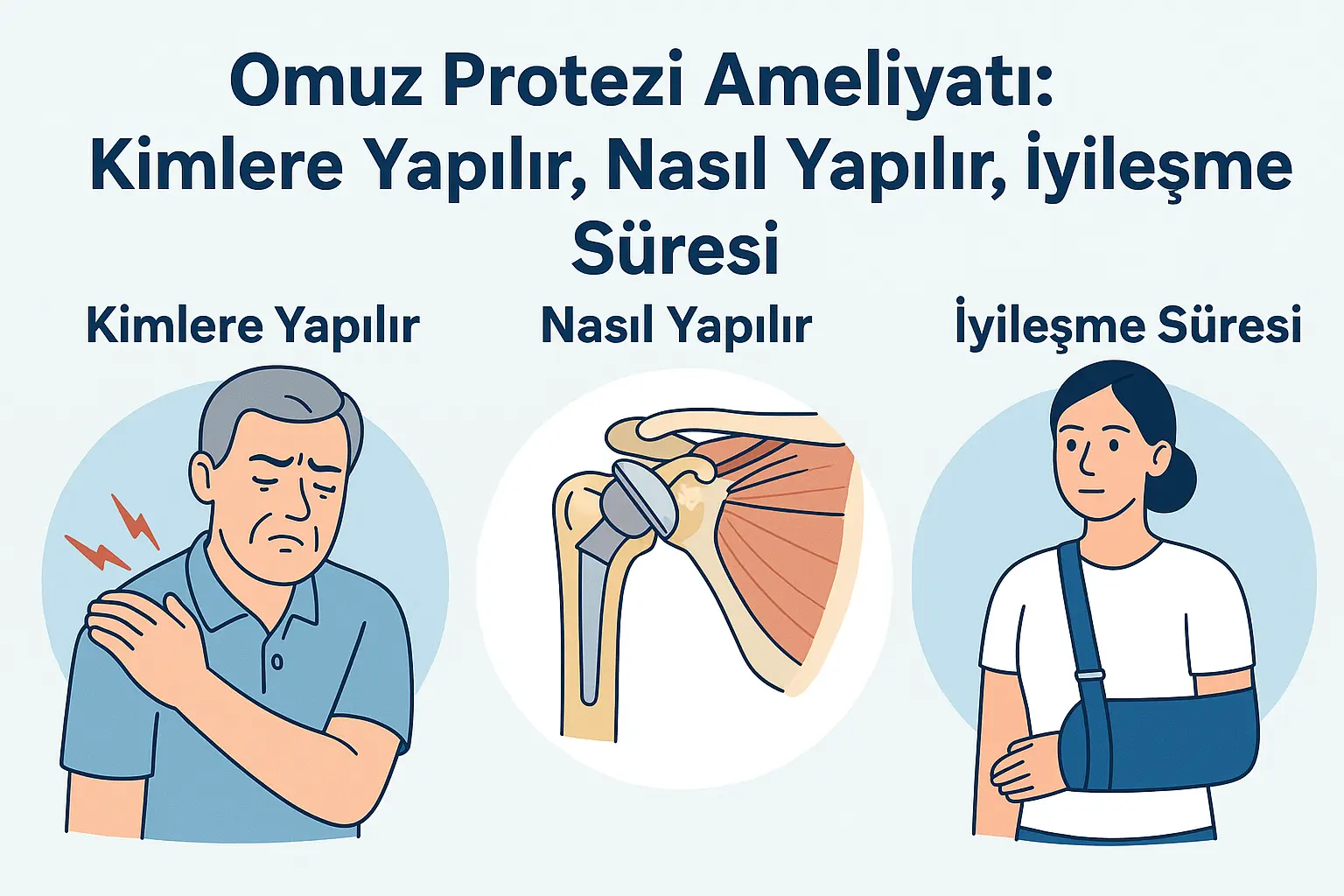
Shoulder replacement surgery is an operation performed to restore joint function and painless movement when the cartilage of the shoulder joint is severely damaged or in severe fractures of the humeral head (upper end of the arm bone). The goal is to reduce/eliminate pain and restore function in daily activities.
Add us as a preferred source on GoogleSee our new articles higher in your searchesAddWhen Is Shoulder Replacement Needed?
Shoulder replacement is considered when irreversible damage has developed on the joint surfaces and pain affecting daily life has appeared. The main conditions that can cause this damage include:
- Osteoarthritis (Degenerative arthritis): Shoulder arthritis is the wear of joint cartilage due to age and use. This leads to bone-on-bone contact and significant pain. Shoulder motion becomes restricted and daily activities get harder.
- Rotator cuff tears: If a tear—especially of the supraspinatus tendon—is not repaired in time, it may lose the chance of repair. This can create mechanical imbalance and, over time, cartilage damage in the joint, which in some patients may progress to a level requiring arthroplasty.
- Shoulder fractures: Particularly in elderly patients with osteoporosis, complex, comminuted fractures involving the humeral head (proximal humerus fractures) may not be fixable, or full function may not be regained after healing. In such cases, arthroplasty becomes an option.
- Inflammatory rheumatic diseases: In conditions where the immune system attacks joint structures—such as rheumatoid arthritis—joint cartilage and subchondral bone may be destroyed over time.
- Avascular necrosis (Osteonecrosis): When the humeral head does not receive sufficient blood flow, bone tissue loses viability. The bone may collapse and joint anatomy deteriorates, which may require arthroplasty.
What Are the Types of Shoulder Replacement?
Shoulder arthroplasty can be performed with different techniques depending on symptoms, the degree of joint damage, and the condition of the soft tissues (especially the rotator cuff). Today, there are four main types of shoulder prostheses:
1. Total (Anatomic) Shoulder Replacement
Total shoulder arthroplasty replaces both the humeral head and the glenoid socket with artificial components. It is one of the most commonly used methods.
In this method:
- A polished metal ball replaces the humeral head.
- A plastic (polyethylene) liner is placed on the glenoid surface.
- Depending on bone quality, implants can be inserted cemented or cementless.
Who is it suitable for?
- Patients with osteoarthritis-related shoulder pain,
- Those with an intact rotator cuff,
- Patients with adequate bone stock in the joint—an ideal option.
Advantage:
It reduces pain and aims to restore shoulder range of motion to the best possible level.
2. Partial Shoulder Replacement (Hemiarthroplasty)
In partial shoulder arthroplasty, only the humeral head is replaced; the glenoid surface is preserved.
When is it preferred?
- Especially when there is a comminuted fracture of the humeral head but the glenoid surface remains intact,
- Or when the glenoid bone stock is severely compromised and a total prosthesis cannot be implanted,
- Additionally, in some rotator cuff tears, it may be chosen to increase load-sharing capacity.
However, note that if the coracoacromial ligament is deficient, partial replacement is not recommended, as its absence can lead to prosthetic instability.
Advantage:
It is more conservative surgery and helps preserve more bone, especially in younger patients.
3. Resurfacing Hemiarthroplasty
Resurfacing hemiarthroplasty is a more minimally invasive technique used to treat cartilage damage of the humeral head. Instead of a stemmed implant, a metal “cap” is fitted over the surface of the humeral head.
Who is it suitable for?
- Patients with an intact glenoid surface,
- No acute fracture of the humeral head,
- Young, active patients seeking a bone-preserving procedure.
Advantage:
It preserves more bone and, if needed, conversion to a total prosthesis is generally easier in the future.
4. Reverse Shoulder Replacement
Reverse shoulder arthroplasty differs from classic systems by altering shoulder biomechanics:
- A metal ball is fixed to the glenoid,
- A plastic socket is implanted on the humerus.
This reversed construct allows the deltoid muscle to power the shoulder.
When is it preferred?
- When the rotator cuff has lost function due to cuff tear,
- In cuff tear arthropathy with advanced arthritis,
- When previous arthroplasty has failed,
- In complex, comminuted humeral head fractures, reverse prosthesis is favored.
Advantage:
By changing the lever system, it enables arm elevation even in cases where a classic total prosthesis would not succeed.
For details: See the Reverse Shoulder Replacement page.
Which Shoulder Prosthesis Is Right for You?
The choice of prosthesis depends on:
- The type and extent of joint damage,
- The integrity of the rotator cuff,
- The condition of the bone (glenoid and humerus),
- Age, activity level, and general health.
This decision must be made by an experienced orthopedic surgeon after thorough clinical and radiological evaluation. Patient participation is essential—understanding which implant is chosen and why matters.
How Is Shoulder Replacement Surgery Performed?
- Surgery is most often performed under general anesthesia.
- In total shoulder arthroplasty, the humeral head is resected; a humeral stem and head are implanted, and a properly sized and oriented component is placed on the glenoid.
- In partial shoulder arthroplasty, only the humeral side is replaced; the glenoid surface is preserved.
- Depending on bone quality and surgeon preference, implants can be fixed cemented or cementless.
Postoperative Course After Shoulder Replacement
The success of shoulder arthroplasty depends not only on a well-executed operation but also on a planned and disciplined rehabilitation program afterward. The program is individualized based on the prosthesis type, rotator cuff status, and the patient’s overall health.
The First Days After Discharge
- Use of an arm sling is generally recommended for 2 to 6 weeks, depending on the procedure and surgeon preference.
- The sling protects the shoulder and supports early healing.
- The incision is typically closed with absorbable subcutaneous sutures or external staples. Staples are removed within a few weeks; absorbable sutures require no intervention.
- Avoid soaking the wound; protect it in the shower until healing is complete, and continue dressings to prevent irritation from clothing.
Home Exercises and Return to Daily Activities
In the first few weeks, it is important to move the shoulder within painless and safe limits. Follow the home exercise program prescribed by your physiotherapist or surgeon consistently.
General Rehabilitation Phases
- Weeks 0–3:
- Pain and swelling control
- Initiation of passive motion (e.g., pendulum exercises)
- Sling use
- Weeks 3–6:
- Transition to controlled active-assisted motion
- Independence in basic daily activities (eating, dressing)
- Weeks 6–12:
- Increase active motion
- Begin light strengthening
- Discontinue the sling
- After Month 3:
- Functional strengthening
- Return to work and adaptation to daily activities
- Contact sports or heavy lifting are planned individually
Do’s and Don’ts After Shoulder Replacement
Do’s
- Stick to the exercise program recommended by your surgeon/physiotherapist.
Exercises can be done 2–3 times a day and may continue for several months. - If needed, get help from a physiotherapist at home.
Don’ts
- Avoid extreme positions such as full abduction or extension behind the body for the first 6 weeks.
- Do not push up from bed or chair using the operated arm—this overloads peri-shoulder muscles.
- For the first 2–6 weeks, do not lift anything heavier than a glass of water.
- Do not be misled by pain-free motion early on; overuse can cause stiffness.
- Avoid driving for 2 to 6 weeks postoperatively.
- Contact sports or repetitive heavy lifting may shorten implant longevity.
Postoperative Expectations
Most patients:
- Return to daily self-care (eating, dressing, personal care) within the first few weeks,
- Experience significantly less pain compared to pre-op,
- Make notable progress in shoulder range of motion and strength,
- Enjoy a meaningful improvement in quality of life.
Possible Risks of Shoulder Replacement
- Infection
- Implant loosening, dislocation/instability
- Shoulder stiffness
- Nerve–vessel injury (rare)
- Periprosthetic fractures
- Bleeding, hematoma
- Long-term wear and need for revision
Implant Longevity
Implant type, surgical technique, shoulder biomechanics, and patient activity level affect longevity. Wear and loosening may occur over the years, in which case revision surgery may be required. (This is broadly similar to principles in total knee and other major joint arthroplasties; we can add experience-based ranges if you wish.)
Frequently Asked Questions About Shoulder Replacement
What is the key difference between total and partial shoulder replacement?
In total replacement, both the humeral head and glenoid surface are replaced; in partial replacement, only the humeral head is renewed. Partial is often preferred for complex humeral head fractures; total is preferred for advanced osteoarthritis, etc.
Will my shoulder be completely normal after surgery?
The aim is pain control and marked functional improvement; most patients return to daily activities with far less pain and better function. However, shoulder biomechanics and the status of the rotator cuff influence the final outcome.
How long does physiotherapy last after shoulder replacement?
Passive motion begins early; active motion and strengthening are introduced between weeks 6–12. Full functional return may take 3–6 months (varies by patient and technique).
At what age is shoulder replacement performed?
More important than chronological age are pain, functional loss, and radiographic severity. With proper indications, it can be performed in both elderly yet active patients and younger patients with severe cartilage damage.
How long does a shoulder replacement last? Will I need another surgery?
Wear/loosening can occur over time; revision may then be needed. Average longevity is generally 10–15 years or more.
After a partial replacement, might I later need conversion to total?
If glenoid-side arthritis progresses over time with increasing pain and functional loss, revision/conversion may be required.
Can I play sports after shoulder replacement?
Activities that do not overload the joint—such as swimming and light-to-moderate resistance training—are usually feasible. Contact sports and heavy lifting are evaluated individually.
What type of anesthesia is used?
Usually general anesthesia; adjunct regional blocks (e.g., interscalene) may be used for postoperative pain control.
When can I drive or return to work?
It depends on the procedure, whether it’s the dominant arm, and job demands; most cases have restrictions during the first 6–8 weeks.
Conclusion
Shoulder replacement involves replacing a severely worn or fractured shoulder joint with artificial components to relieve pain and restore function. The choice depends on the underlying problem: if the rotator cuff is intact, an anatomic (total) replacement is preferred; if only the humeral head is damaged, a partial replacement may be suitable; if the cuff is nonfunctional, a reverse replacement that changes joint mechanics is considered.
The primary goal is to enable patients to perform daily activities without pain. Success depends not only on surgical technique but also on a meticulous, months-long physiotherapy program after surgery. Consistent rehabilitation is essential to maintain and strengthen the regained motion.
Shoulder arthroplasty is not a “one-size-fits-all” operation. Success hinges on matching the right diagnosis with the right implant. For example, using a reverse prosthesis in a patient with an intact rotator cuff is as inappropriate as placing an anatomic prosthesis in a patient with a completely torn cuff. Therefore, the surgeon’s experience and a detailed evaluation are critical.
Early postoperative pain relief should not be misleading; healing is a process. Strict adherence to the exercise plan and restrictions directly affects implant longevity and success. The aim is not to return to heavy sports, but to achieve a comfortable, pain-free daily life.
Thank you for reading this detailed and informative article.
For an individualized assessment and to determine the most appropriate treatment for you, please contact Utku Erdem Özer. For more information, you can use our contact channels or book an appointment directly.