What is a proximal humerus fracture? How long does it take to heal? Is surgery necessary? Can it heal with physical therapy alone? Orthopedic surgeon Op. Dr. Utku Erdem Özer explains everything in detail.
Добавьте нас в предпочитаемые источники GoogleНаши новые статьи будут выше в вашем поискеДобавитьA proximal humerus fracture is the most common type of shoulder fracture. It typically occurs in middle-aged and elderly patients with osteoporosis as a result of a fall onto an outstretched hand.
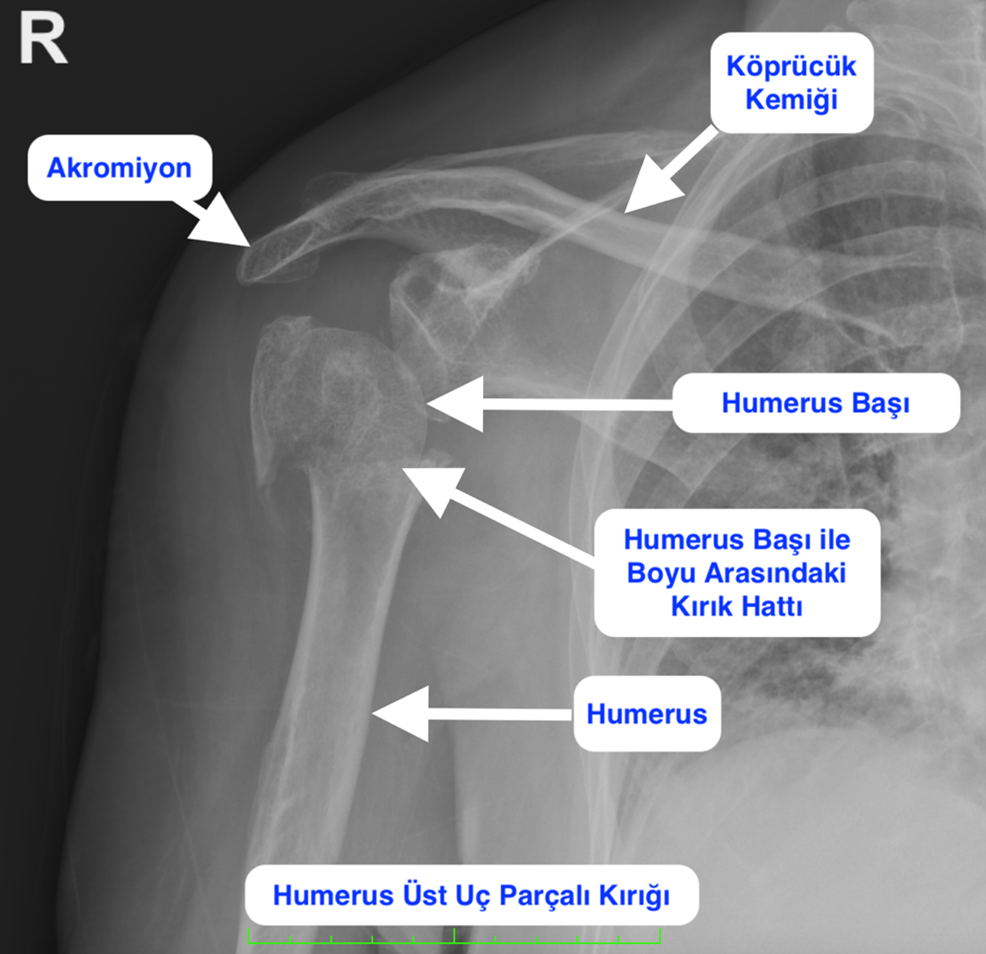
While proximal humerus fractures are usually diagnosed via X-ray, advanced imaging such as CT or MRI may be required if surgery is considered.
A non-displaced proximal humerus fracture can be treated with a simple arm sling. However, in displaced, 3- or 4-part fractures, surgery is often required. Surgical options include fixation with plate and screws or shoulder replacement. Healing and bone union typically occur within 6 to 12 weeks.
What Is the Humerus?
The humerus, also known as the upper arm bone, is the bone between the shoulder and elbow joints. It articulates with the scapula at the shoulder to form the shoulder joint, and with the radius and ulna bones at the elbow to form the elbow joint.
In proximal humerus fractures, the most commonly affected anatomical parts are the humeral head, neck, greater tubercle (tuberculum majus), and lesser tubercle (tuberculum minus).
What Is a Proximal Humerus Fracture?
A proximal humerus fracture refers to a break in the upper part of the humerus, near the shoulder joint. It commonly occurs in elderly patients with osteoporosis due to low-energy falls. In younger individuals, it usually results from high-energy trauma such as car accidents or bicycle falls.
Types of Proximal Humerus Fractures
The classification of a proximal humerus fracture depends on which anatomical parts of the humerus are affected. Depending on the severity of the trauma, the fracture may involve a single region or multiple regions. These areas include:
- Greater tubercle (tuberculum majus)
- Lesser tubercle (tuberculum minus)
- Surgical neck
- Humeral head
Based on the involvement of these parts, proximal humerus fractures can be classified as:
- Greater tubercle fractures
- Lesser tubercle fractures
- 3-part proximal humerus fracture
- 4-part proximal humerus fracture
Greater Tubercle Fractures
Greater tubercle fractures of the proximal humerus are commonly seen during anterior shoulder dislocations. However, in osteoporotic patients, these fractures may occur even without a dislocation.
The greater tubercle serves as the attachment site for the supraspinatus and infraspinatus tendons of the rotator cuff. A key concern with greater tubercle fractures is that even if the fracture is initially non-displaced, it can become displaced over the course of 1–2 weeks due to the pull of these tendons. A fracture that initially did not require surgery may become a surgical case during follow-up.
A frozen shoulder may develop following greater tubercle fractures. You can click the link to learn more about frozen shoulder.
Treatment of non-displaced greater tubercle fractures is done with an arm sling. Bone healing usually occurs within 4–6 weeks of immobilization.
Displaced greater tubercle fractures require surgery. Surgery for greater tubercle fractures is often performed as a minimally invasive procedure and can even be done arthroscopically. Once the fracture is reduced, it is fixed in place with one or two screws.
Lesser Tubercle Fractures
The lesser tubercle is the bony prominence where the subscapularis tendon attaches. Fractures of the lesser tubercle are rare and are most commonly seen in posterior shoulder dislocations. These dislocations may occur due to epilepsy or electric shock injuries. Lesser tubercle fractures should be carefully evaluated, and if displaced, surgical treatment is necessary.
Displaced lesser tubercle fractures can lead to subscapularis tendon insufficiency. In such cases, surgical intervention with tendon transfer may be required.
3- or 4-Part Proximal Humerus Fractures
In 3- or 4-part proximal humerus fractures, the fractured components typically include the greater tubercle, lesser tubercle, humeral head, and surgical neck. These complex fractures are most commonly seen in elderly patients with osteoporosis.
Symptoms of Proximal Humerus Fractures
The most common symptoms include:
- Pain in the shoulder region
- Inability to move the shoulder or arm
- Severe pain when attempting to move the arm
- Sudden swelling around the shoulder
- Bruising, which may extend down to the elbow after a few days
How Are Proximal Humerus Fractures Diagnosed?
Patients presenting with shoulder pain after a fall should first undergo a physical examination, followed by X-rays of the shoulder.
If the fracture is complex or involves the joint surface, a CT scan (Computed Tomography) is required for detailed evaluation.
In certain cases, MRI imaging may also be needed to assess the viability of the humeral head or to check for rotator cuff tears.
Treatment of Proximal Humerus Fractures
When deciding how to treat any fracture, certain key criteria are assessed:
- Are the fracture fragments displaced?
- If displaced, how much displacement is present?
- Is there a risk that the fracture will displace further during healing?
A detailed evaluation is essential to determine the most appropriate treatment method — and this same approach applies to proximal humerus fractures.
For a definitive diagnosis and personalized treatment, please feel free to contact us through our contact page.
Non-Surgical Treatment of Proximal Humerus Fractures – Upper Arm Fracture Brace
If the fracture is a hairline crack or non-displaced, it can be treated without surgery. Management includes rest, ice, an arm sling, and/or a Velpeau bandage, which is a specialized upper arm fracture brace.
As with all fractures, regular follow-up with X-rays every week or 10 days is crucial to monitor healing.
Physical Therapy for Proximal Humerus Fractures
The physical therapy program for proximal humerus fractures is tailored to each patient based on fracture type, severity, and overall health condition. The typical rehabilitation plan includes:
Range of Motion Exercises
Physical therapists prescribe gentle mobility exercises to increase the range of motion in the shoulder. These are gradually intensified to help prevent joint stiffness.
Strengthening Exercises
To prevent muscle weakness and rebuild strength, especially in the shoulder, arm, and back muscles, strengthening exercises are essential.
Balance and Coordination Exercises
These exercises help restore balance and coordination, facilitating the return to daily activities after a humerus fracture.
Exercise Therapy for Proximal Humerus Fractures
Here are some basic exercises recommended during the recovery period:
Shoulder Lifts
Raise your shoulder slowly and then lower it back down. Repeat this movement 10–15 times at a comfortable pace.
Wall Pushes
Step forward slightly and place your hands on a wall. Push your body toward the wall with straight arms, then slowly return to the starting position. Repeat 10–15 times.
Dumbbell Lifts
While seated, lift a light dumbbell with the injured arm and then lower it. Perform this exercise in a slow, controlled manner, 10–15 repetitions.
Elbow Bends
With your injured arm, bend the elbow while supporting it on a firm surface. Slowly bend and then extend the elbow. Repeat 10–15 times.
⚠️ If you feel discomfort or pain while doing these exercises, stop immediately and consult your doctor. Ideally, start these exercises under the supervision of a licensed physiotherapist.
Proximal Humerus Fracture Surgery
Once the diagnosis is confirmed, the decision for shoulder fracture surgery is made. The need for proximal humerus fracture surgery is determined based on the following criteria:
- Is the fracture comminuted (broken into multiple pieces)?
- How far have the fragments shifted or rotated?
- What is the patient’s age and activity level?
- Is there an associated shoulder dislocation?
After thorough evaluation, the appropriate surgical plan is created.
How Is Proximal Humerus Fracture Surgery Performed?
Surgical treatment of a proximal humerus fracture involves either fixation with plate and screws or a shoulder replacement.
The critical factor in surgery is whether the fracture — especially if it is comminuted — can be reconstructed like a puzzle and fixed in a way that will allow proper bone healing with plate and screws.
In elderly patients, 3- or 4-part fractures are common. Even when such fractures are reconstructed perfectly and fixed with plate and screws, healing may still fail.
For this reason, shoulder replacement surgery is often preferred for 3- or 4-part fractures in elderly patients.
To learn more about shoulder replacement, click the link.
Plate and Screw Fixation for Proximal Humerus Fractures
If the fracture is displaced, comminuted, or accompanied by dislocation, surgery becomes inevitable.
As with any fracture, the goal is to anatomically reduce the bone fragments and stabilize them with plate and screws strong enough to allow early postoperative shoulder movement.
The surgeon accesses the fracture through an incision at the front of the shoulder. Efforts are made to avoid completely exposing the fragments, as the rotator cuff tendons are often still attached. These tendons are used to manipulate and reposition the fragments.
Intraoperative X-rays are taken frequently to confirm each surgical step. If some fragments are too crushed to heal on their own, bone grafting may be required — either from a tissue bank or the patient’s pelvic bone.
Recovery Time After Proximal Humerus Fracture Surgery
After surgery, the patient typically stays in the hospital for one night. An arm sling is used for about 2–3 weeks. Within 3–4 days, simple exercises such as pendulum swings and table slides are initiated.
At the 6-week mark, an X-ray is taken. If everything appears satisfactory, a rehabilitation program begins to increase range of motion and strengthen the shoulder muscles.
Bone healing (union) generally occurs within 6 to 12 weeks.
Proximal Humerus Fracture – Patient Testimonials
Here are some testimonials from patients treated by Dr. Utku Erdem Özer for humerus fractures:
- Ayşe Y.
«Thanks to Dr. Utku Erdem Özer’s treatment, I recovered quickly from my humerus fracture. He is incredibly professional and attentive. He guided me through every step and supported me during the entire healing process. Thank you!» - Mehmet D.
«I chose to see Dr. Özer for my humerus fracture, and I’m glad I did. His empathetic approach and effective treatment helped me recover in a short time. I highly recommend him to everyone.» - Fatma K.
«Dr. Utku Erdem Özer provided excellent care for my humerus fracture. Both the surgery and postoperative follow-up were very successful. I’m truly grateful.»
Conclusion
As the population ages, proximal humerus fractures are becoming increasingly common. In elderly patients with osteoporosis, these fractures are often comminuted into 3–4 pieces. When the bone fragments are crushed or fragmented, patients should be prepared for surgical treatment.
Thank you for reading our article. For more information, you may visit the homepage of utkuerdemozer.com.